Online sales
www.upc.sk
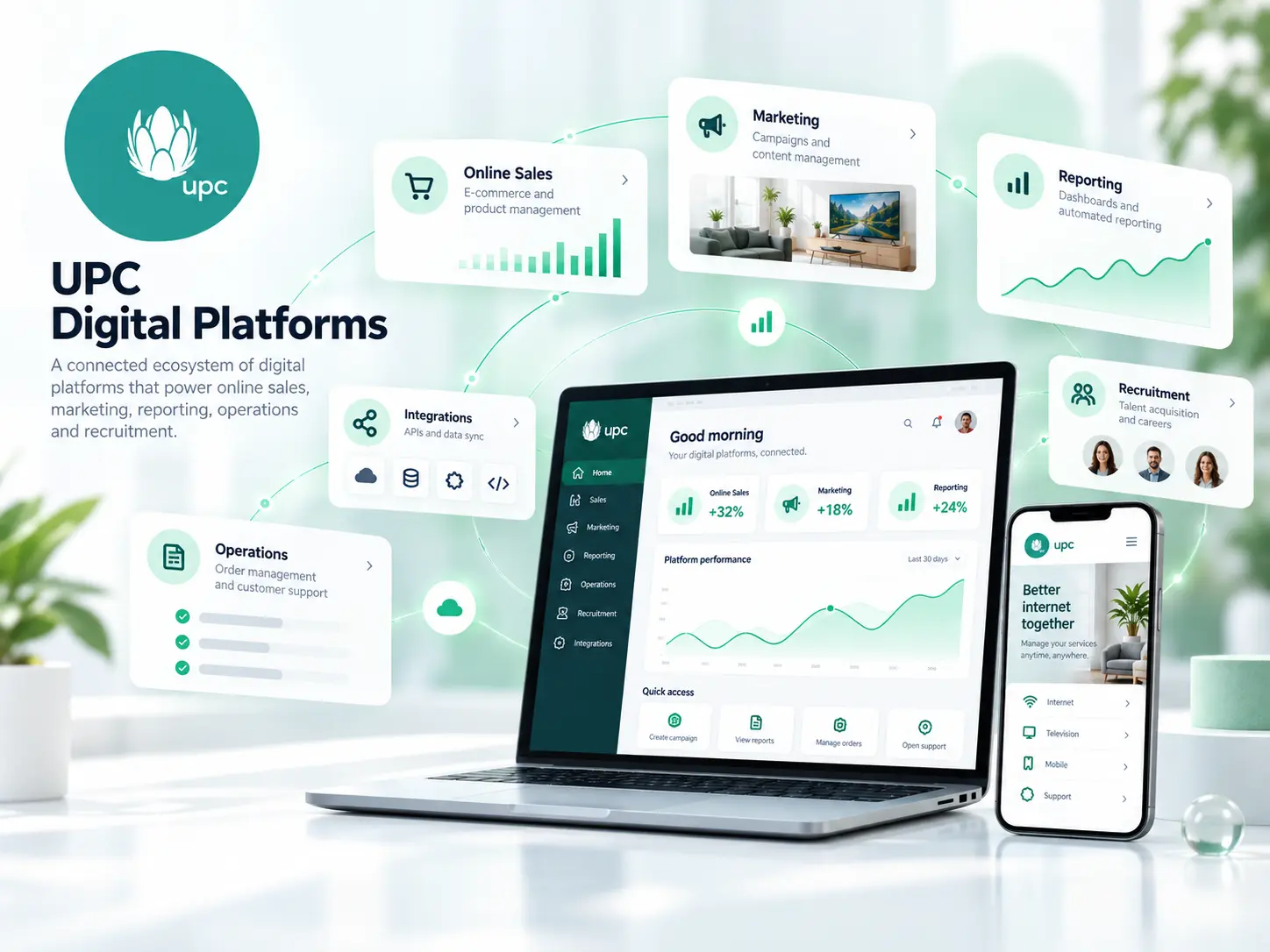
The corporate website was the starting point of my work at UPC and gradually became part of a much broader local digital ecosystem supporting online sales, content and customer journeys.
Web platforms · Integrations · Reporting
From a corporate website role to building local digital platforms supporting online sales, marketing, reporting and day-to-day operations.
Overview
I joined UPC to support and develop the corporate website, initially in a webmaster role. The scope soon expanded far beyond website administration.
As local business needs evolved, I began designing and developing dedicated platforms running on local infrastructure — tools tailored to online sales, marketing, operational workflows, reporting and system integrations.
Over time this became a connected digital ecosystem rather than a single website project. Several of these platforms have remained part of daily business operations for years and continue to evolve as the organisation changes.
Evolution
What started as responsibility for the corporate web presence gradually became ownership of a much wider set of digital capabilities.
When local requirements could not be solved efficiently by the central corporate platform, I built dedicated solutions for the Slovak market: customer-facing journeys, internal applications, integrations, automated processes and reporting.
This meant working directly with real operational needs and taking products from an initial idea through architecture, development, deployment, maintenance and continuous improvement.
How it evolved
01
Managing and developing the local UPC web presence and supporting digital content and campaigns.
02
Building dedicated applications for orders, recruitment, content, internal workflows and online operations.
03
Connecting platforms through APIs, automation, reporting and data synchronisation across marketing and operational systems.
Platform examples
The platforms served different teams and workflows, but shared a common goal: make the local online channel more effective, measurable and easier to operate.
Online sales
The corporate website was the starting point of my work at UPC and gradually became part of a much broader local digital ecosystem supporting online sales, content and customer journeys.
Operations
Internal platform supporting order workflows, operational processing, exports and the connection between online acquisition and downstream teams.
Integrations & reporting
Internal integration and reporting platform connecting orders, leads, marketing systems, scheduled imports, APIs and reporting workflows.
Recruitment
Recruitment platform supporting job presentation, employer communication and locally managed recruitment content.
Capabilities
Product presentation, customer journeys, order capture and tools supporting digital acquisition.
Dashboards, exports and automated reporting designed around operational and marketing requirements.
Connections between local platforms, corporate systems, external APIs and marketing services.
Scheduled imports, synchronisation, processing and recurring workflows that replaced repetitive manual tasks.
Lead flows, campaign support, attribution data and systems connecting acquisition activity to business outcomes.
Practical internal interfaces designed around the workflows of teams using them every day.
Integrations
A significant part of the work was connecting platforms with other systems: exchanging data, consuming APIs, pushing leads and orders, synchronising marketing information and preparing data for reporting.
Typical workflows
Order synchronisation
Lead processing
API integrations
Marketing platform synchronisation
Scheduled imports & exports
Reporting data preparation
Automated recurring processes
Long-term ownership
These were not one-off launches. Many of the platforms evolved continuously as products, processes, providers and business requirements changed.
Long-term ownership meant maintaining existing workflows while gradually modernising code, adding integrations, improving reporting and adapting systems to new requirements without disrupting daily operations.
That continuity is one of the most important outcomes of the work: tools created for local needs became durable parts of the online operating model.
My role
Impact
From website to ecosystem
The original corporate web role expanded into multiple customer-facing and internal platforms.
Built for daily use
Several systems became long-term operational tools and continue to support real business processes.
End-to-end ownership
Architecture, development, integrations, deployment, maintenance and continuous improvement.
Next case study
DostupnyInternet.sk